
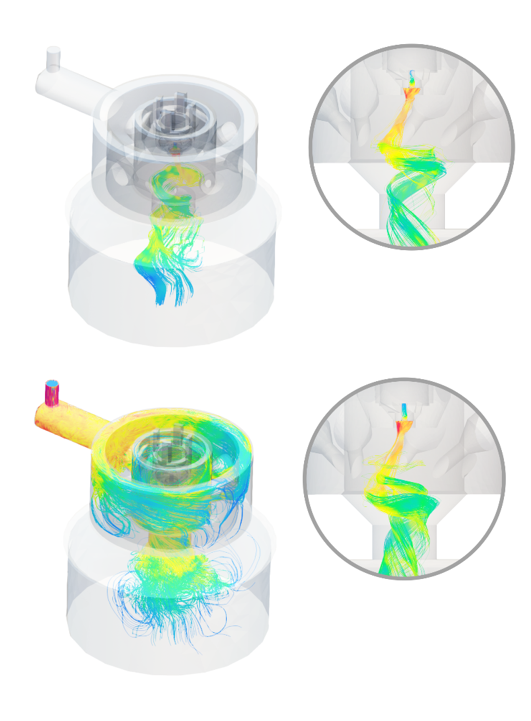
A collaboration between Oak Ridge National Laboratory (ORNL) and the University of Maine has produced a new method for drying cellulose nanofibers—one that could make large-scale production practical for the first time. The technique uses counter-rotating vortices of heated compressed air, generating intense shear forces that prevent fibers from clumping during dehydration. It’s a process the researchers liken to tiny tornadoes.
The problem is straightforward. Cellulose nanofibers—derived from wood pulp ground into a gel-like slurry of roughly 97% water—have properties that make them useful in stronger concrete, biodegradable packaging, medical implants, and automotive components. But drying these fibers without causing irreversible aggregation has been a bottleneck for years. Freeze drying works at small batch sizes, though it’s energy-intensive and difficult to scale. Spray drying scales better but produces lower-quality output because fibers clump together.
University of Maine chemical engineering professor David J. Neivandt first hypothesized in 2018 that high-shear conditions during drying could limit aggregation. His team has since developed a patent-pending nozzle system that rapidly dehydrates nanocellulose using counter-rotating air vortices. The result: lower energy consumption, higher yield, and better fiber quality compared to conventional methods.
ORNL’s computational modeling added another dimension. Researcher Kevin Doetsch found that air enters the vortex generators at Mach 3—three times the speed of sound—tearing apart slurry droplets and drying them rapidly. “We can see why the nanomaterials are drying the way they are, and we can prove it computationally,” Doetsch said.
Peter Wang, a research staff scientist in ORNL’s Manufacturing Science Division, described the raw material in simple terms: “Cellulose nanofibers are like branches on a tree. You have a trunk that’s smaller than the diameter of a hair, but then the ends continue to split until you have fuzzy ends that are nano-size.”
The next step is to scale throughput significantly. The current lab-scale system produces grams of dried nanocellulose per day; the team is designing hardware to reach kilograms. That jump would bring the process closer to commercial viability for industries including packaging, construction, marine, and automotive manufacturing.
This research is part of the SM2ART Program, funded by the U.S. Department of Energy’s Advanced Materials and Manufacturing Technologies Office, which supports scaling natural, low-energy materials for industrial use.
Article & image source: Oak Ridge National Laboratory
