
If you’ve ever opened an oven door and felt that moment of uncertainty—wondering if this run behaved the way it should—you already know industrial oven processes decide far more than surface appearance. They influence whether a coating cures properly, whether an adhesive holds, and whether a composite stays stable after cooling.
People often blame the oven when something goes wrong, but most issues come from the process running inside it. If heat, airflow, load patterns, soak time, or atmosphere shifts, product quality shifts with them.
When you get the process right, the oven becomes the most predictable thing in the plant. But get it wrong, and even good equipment will produce inconsistent results.
How industrial oven processes influence quality
Every industrial oven for manufacturing promises to hit a setpoint. But a controller reading isn’t the same as the conditions your parts experience. A ramp that’s a bit too aggressive, a soak trimmed to save time, or a load arranged to squeeze more in can change how materials behave.
Once your oven processes are defined and protected, the difference shows up fast. There will be less scrap, fewer surprises, and your production line is consistent from shift to shift.
What goes into an oven process
A good process is a repeatable sequence:
- How fast parts heat
- How long they stay at temperature
- How they cool
- How air moves around the load
- How the load is spaced and supported
- What atmosphere surrounds the parts
- What data the oven records
Different types of industrial ovens can support the same process if they can deliver these conditions reliably. The process should always come first. You choose an oven that supports the process. You don’t change the process to match the oven.
Heating profiles are where consistency is won or lost
Most failures trace back to heating profiles.
Fast ramps might look efficient, but they can trap solvent, stress multi-material assemblies, or leave core temperatures far behind the surface. Controlled ramps allow heat to move evenly and give volatiles a way out.
Soak time is just as sensitive. Cut it too short and the reaction doesn’t finish; extend it too long and materials can dry out, shift color, or lose flexibility.
And allowing parts to cool in an uncontrolled way introduces distortion and variations that often don’t show up until later. One of the simplest ways to improve consistency is to properly define cool-down.
The impact of airflow and loading
Oven uniformity depends as much on how you load the oven as on the oven’s design. You can only expect good airflow patterns (vertical, horizontal, or recirculating) if the load leaves room for air to move.
Nested parts, mixed masses on one shelf or a tray that blocks a return path can create 10–20°C swings that the controller doesn’t register. That’s why strong industrial oven processes always include loading rules that align with real production conditions.
Conveyor ovens add another variable: belt speed. Speeding up the line just a bit changes your cure time whether you mean to or not.
Atmosphere, cleanliness, and safety
Heat alone isn’t the full story. Some materials react badly to oxygen. Others need controlled exhaust to prevent surface defects or bonding issues. Sensitive products like electronics, optics, and medical components need filtered airflow to avoid contamination.
If solvents or flammable vapors are part of the process, NFPA 86 safety features aren’t there just for compliance. They stabilize conditions, keep purge cycles consistent, and reduce the risk of a mishap that ruins the product and the equipment.
Matching the process to the right oven
Once the process is defined, the choice of oven becomes more straightforward. Instead of shopping by guesswork, you’re matching performance to need.
| Process Need | Typical Industrial Oven for Manufacturing |
|---|---|
| Small-batch clean drying for sensitive components | Benchtop or lab oven with HEPA filtration |
| Medium-volume metal coating cures | Reach-in cabinet oven with recirculating airflow |
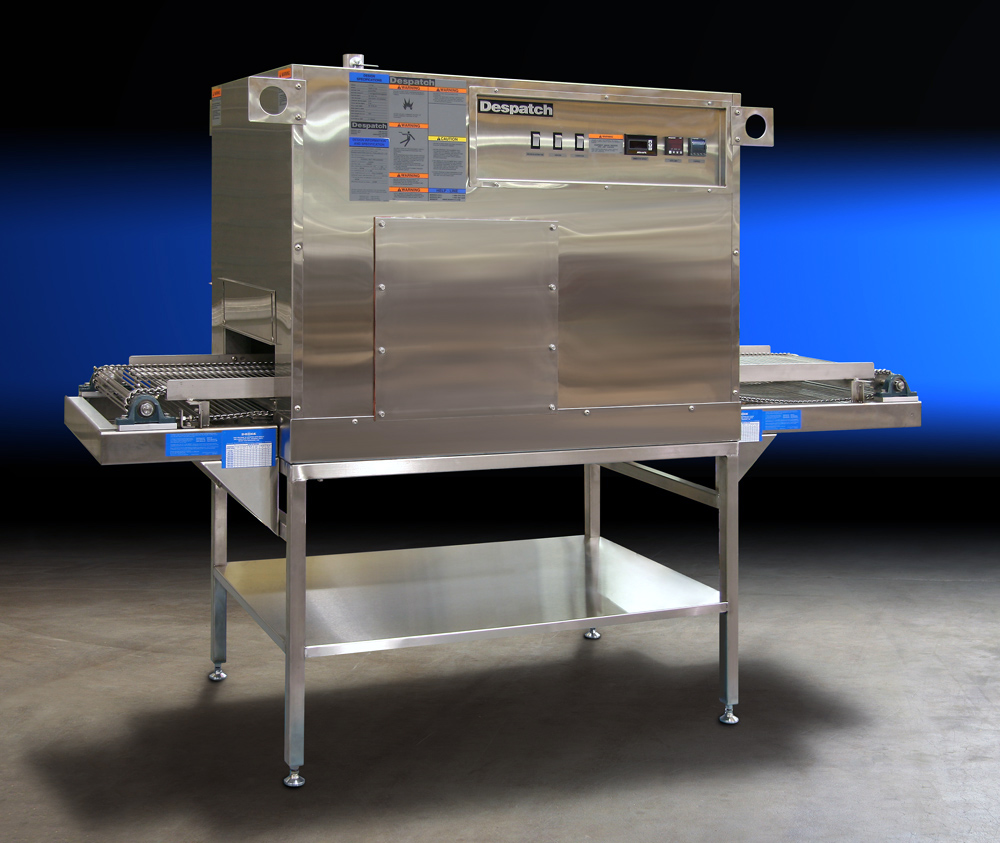
| High-throughput adhesive cure | Multi-zone conveyor oven |
| Large tooling or cart-based composite cure | Walk-in or truck-in oven |
And scaling from development to production is also much simpler when the process is stable. You can prove a profile on a benchtop unit, transfer it to a cabinet or conveyor oven, and then run a temperature-mapping check to confirm the profile behaves the same at production scale.
Controls, recipes, and keeping the process steady
Controls prevent processes from drifting. You can lock in decisions about ramp, soak, limits, and alarms with stored recipes. And then rely on data logging to show what happened, rather than what was supposed to happen.
You’ll see the fewest surprises once you treat oven settings as controlled documents instead of mere suggestions. Then you can count on the oven being a steady part of the manufacturing system, rather than a source of variability.
If you’re refining an existing process or building a new one, our product specialists can help you match airflow, profiles, and load design to the right Despatch oven platform.
