
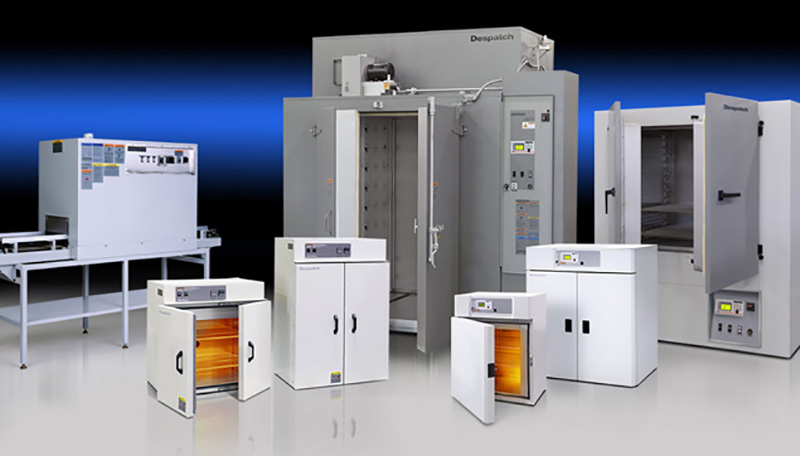
Let’s face it. Buying an industrial oven is challenging. It can become time-consuming and cumbersome. The key to buying an industrial oven that’s right for your application is clearly understanding your needs. Not understanding them makes buying an industrial oven a hit-and-miss proposition. The last thing you want to do is buy the wrong oven—a costly mistake.
Below are seven critical questions you need to answer before buying an industrial oven. Answering them provides a clear understanding of your needs. It also simplifies and streamlines the selection process. In the end, you’ll get an industrial oven that’s not only reliable, cost-effective, and easy to maintain and operate but also right for your application.
1. What’s your application?
Knowing what you want your oven to do determines what features and capabilities you need. Will you be using your oven to anneal, cure, or dry? Or will you be using it to bake, sterilize, or heat treat? What material will you be processing? What kind of environment will it be in—laboratory, clean room, industrial space? Nailing down this information is critical to finding the right industrial oven.
Your application also affects the level of temperature stability and airflow control you’ll need. Some curing or drying processes may tolerate broader temperature swings, while others—such as heat treating or medical device preparation—often require tighter uniformity and precise rate control. If your process is part of a validated workflow, note any required documentation, alarms, or monitoring so the oven is configured correctly from the start.
2. What type of industrial oven do you need?
Industrial ovens are typically configured for either batch or continuous processing. Batch ovens are known for their flexibility. They’re ideal for applications where load size and production volumes vary substantially. Continuous process ovens are ideal for applications where large quantities of similar products or parts are being processed. Continuous ovens also reduce handling, maximize throughput, and ensure consistent thermal processing times for parts or products.
In addition to batch and continuous designs, think about whether your production schedule might change over time. A batch oven supports many different product types with varied dwell times, while a conveyor oven supports predictable, repeatable movement through defined heat zones. Suppliers can also advise when hybrid layouts or specialty loading systems might support your part flow more efficiently.
3. What chamber size do you want?
Factors affecting chamber size include the product or part’s size, the number of products in each batch, and your daily processing needs. You also want to consider the space between parts or products. Too small a space inhibits performance. Too large a space wastes energy. Plus, you need to consider the oven’s size, airflow needs without unnecessary loss, and chamber construction (such as stainless steel or mild steel, depending on temperature, cleanliness, and corrosion requirements).
It’s helpful to sketch out your typical load arrangement. This can reveal whether you need adjustable shelving, removable racks, or extra depth to handle future product revisions. Also consider the space required for loading tools, hoists, or carts, since these can influence the minimum chamber dimensions and door configuration you’ll need. Larger assemblies or carts may fit better in a walk-in or truck-in oven.
4. What about temperature requirements?
Factors to consider here include maximum/minimum temperatures, required dwell time at temperature, overall cycle time, and the heat-up and cool-down rates. You also want to consider the type and amount of product load, the heating capacity needed to bring the product to temperature within the specified time, and the oven’s overall capacity. Does the oven have sufficient heating capacity to bring the product to the desired temperature within a specified cycle time? Do you need to control the temperature rate?
Temperature requirements often change with load density and part mass. A heavier load may require more heating capacity or a longer dwell time to reach the desired temperature. If you work with multiple recipes, note the fastest heat-up rate and the slowest cool-down rate you can accept, as these will influence heater capacity and airflow selection.
5. How critical is temperature uniformity in industrial ovens?
Temperature uniformity generates consistent heat processing results. Confirm the temperature uniformity before buying an oven. Some factors impacting uniformity include cold air stratification, placement of workload, and the controller’s accuracy and response speed. A nine-point uniformity test verifies temperature variation across multiple locations in the chamber, helping confirm that the oven meets the required uniformity specification.
Uniformity is also influenced by how consistently the controller responds to small changes during the cycle. Look for controller accuracy, sensor placement, and any documented calibration procedures. If your process is sensitive to overshoot or undershoot, discuss whether rate-of-change control or additional monitoring points would help you maintain steady conditions. Applications that require tighter uniformity may benefit from laboratory ovens, which are designed for small-batch precision.
6. What’s the best airflow for your industrial oven?
How you load your product determines your airflow type—vertical, horizontal, or uniflow. “If you load your product on solid trays, horizontal airflow is often effective. You’ll also need to consider how you space parts with each type of airflow. Does the setup ensure optimal airflow through or around all parts? Often, a forced convection oven with recirculating airflow provides the best distribution of heat for an application.
When evaluating airflow, consider the trays or fixtures you use. Solid trays behave differently from perforated ones, and dense or irregular loads may need a specific airflow pattern for even heating. Suppliers can help you compare patterns using sample loads or airflow diagrams so you can see how heat moves through your parts.
7. What about design/construction considerations?
Two factors are critical here: maximum oven temperature and work-chamber size. Several process-specific factors, such as cleanability, easily readable controls, and resistance to corrosion, are also critical when selecting an oven. Plus, you’ll need to consider what floor type is best for your application. You should also review oven interior considerations and applicable standards.
Construction choices also affect long-term serviceability. Stainless steel interiors may support frequent cleaning or corrosive environments, while reinforced floors help when handling heavy carts or tooling. Ask about insulation thickness, door sealing, and how the oven manages thermal expansion, since these influence energy use, stability over time, and overall longevity.
Two other considerations when buying an industrial oven are your special processing needs and the type of controller needed.
Questions to Ask Your Oven Supplier
Clear answers from a supplier help you confirm whether an oven will truly meet your operating, quality, and compliance needs. These questions give you a practical way to compare vendors and verify that their equipment will support long-term reliability and straightforward operation.
Ask for documented temperature data
Request recent uniformity test results, including how the oven performed during a nine-point test. Reliable suppliers can share data showing how an unloaded oven behaves from edge to edge, along with guidance on how load size might affect the temperature profile.
Clarify airflow verification
Different airflow patterns suit different types of trays, racks, and part geometries. Ask how the supplier tests airflow distribution and whether they can demonstrate how the chosen pattern supports your loading method.
Confirm installation requirements
Clarify power supply needs, exhaust connections, floor loading, and the space required for clearances and service access. These details influence where the oven can be installed and whether additional building work is needed.
Discuss controller capabilities
Controller strengths vary widely. Some projects call for simple set-point control, while others need ramp/soak programming, data recording, network access, or alarm outputs. A supplier should be able to explain which controller options fit your process and what documentation is included.
Check support for regulated or high-reliability environments
If your process operates in a cleanroom or under industry standards, ask about HEPA filtration, Class A safety configurations in accordance with NFPA 86, or mechanical features that support audit-ready operation.
Review maintenance expectations
Every oven needs periodic checks. Ask how often inspections are recommended, whether spare parts are easily accessible, and what the typical service path looks like throughout the equipment’s life.
Understand lead times and service availability
Lead time varies by model, configuration, and production demand. Request a realistic window and ask whether parts and technical support are available from the same vendor or through authorized providers.
Steps in Buying a New Industrial Oven
Answering the questions listed above is the first step in buying an industrial oven. Below is a step-by-step approach to making the purchase after you’ve determined your needs:
- Study current industrial oven trends
- Document your needs
- Determine selection criteria
- Review industrial oven vendors
- Narrow down the list to four or five
- Schedule a consultation with vendors
- Choose an industrial oven that meets your needs
- Install the new industrial oven
- Schedule training on the new oven’s operation
- Schedule safety training sessions
- Develop a preventive maintenance program
- Set up a regular cleaning program
- Conduct periodic maintenance testing
Any testing or inspections you schedule should follow a well-defined plan. You should also log all testing and inspection results.
We hope this article helped. If you still have questions about buying an industrial oven, you can check out our field guide to buying an industrial oven. Or call our skilled customer service team to assist you.
