
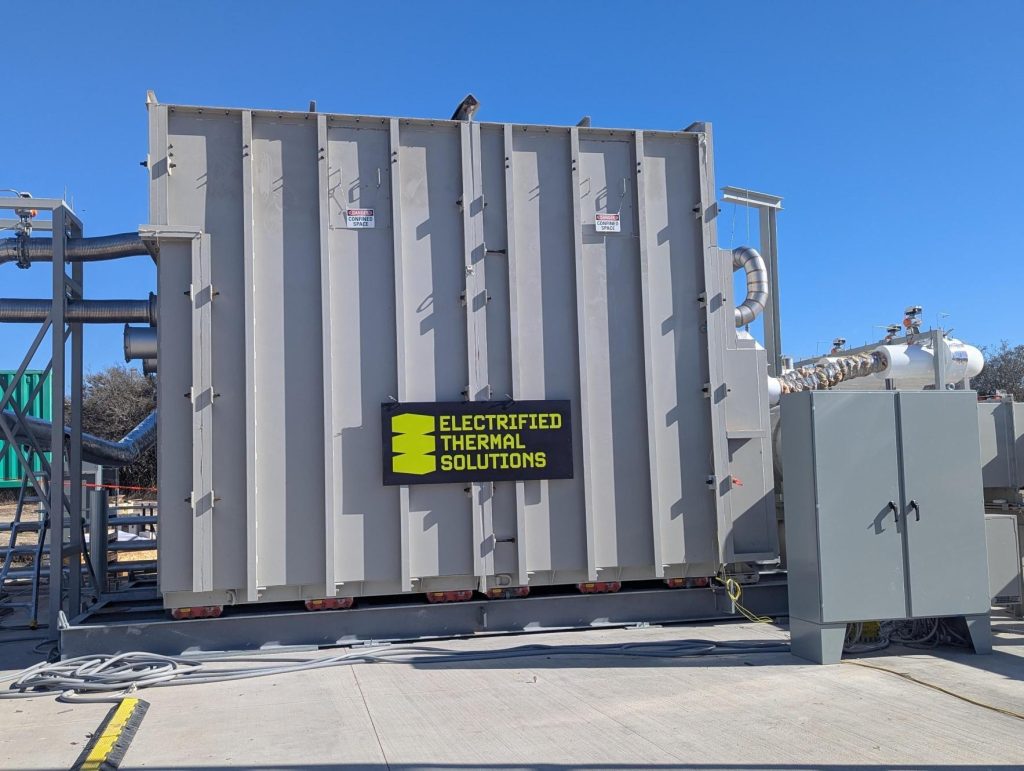
Electrified Thermal Solutions has commissioned its first commercial-scale Joule Hive thermal battery at Southwest Research Institute (SwRI) in San Antonio, Texas. The system stores up to 20 MWh of high-temperature heat and supplies industrial process heat using grid electricity rather than direct fossil fuel combustion.
The Joule Hive™ charges using standard 13.2 kV AC power and delivers hot gas at temperatures up to 1,800°C. Operators can modulate output for applications ranging from chemical processing and metals production to cement and glass manufacturing. By charging during off-peak hours, facilities can stabilize heat costs while reducing direct combustion on site. That load flexibility also allows plants to respond to grid conditions and shifting electricity prices.
The system relies on electrically conductive firebricks that both store and release thermal energy. These bricks are engineered for durability under repeated high-temperature cycling and mechanical stress. The modular design supports installations from roughly 1 MW to 5 MW, with multiple units combined for larger industrial loads. The architecture allows facilities to phase in capacity as production expands.
For Despatch readers working with industrial ovens, furnaces, and heat treatment systems, this development signals a broader shift in how process heat may be supplied. Electrified thermal storage could supplement or replace combustion-based systems used in curing, drying, calcining, or preheat operations. It may also support hybrid configurations where electric heat works alongside gas-fired systems to balance cost, emissions, and uptime. As more manufacturers electrify operations, integration between heat storage systems and precision oven controls will become increasingly important.
Electrified Thermal reports strong early interest from manufacturers in metals, minerals, food processing, and pulp and paper. With the SwRI unit now operational, broader commercial deployments are scheduled for later this year.
What to watch next
Industry observers should monitor early performance data from the SwRI installation, particularly cycle durability, response time, and energy cost comparisons. Additional project announcements in 2026 will indicate how quickly electric thermal storage moves from pilot stage into mainstream industrial adoption.
Image & Article Source and date: Electrified Thermal Solutions
