
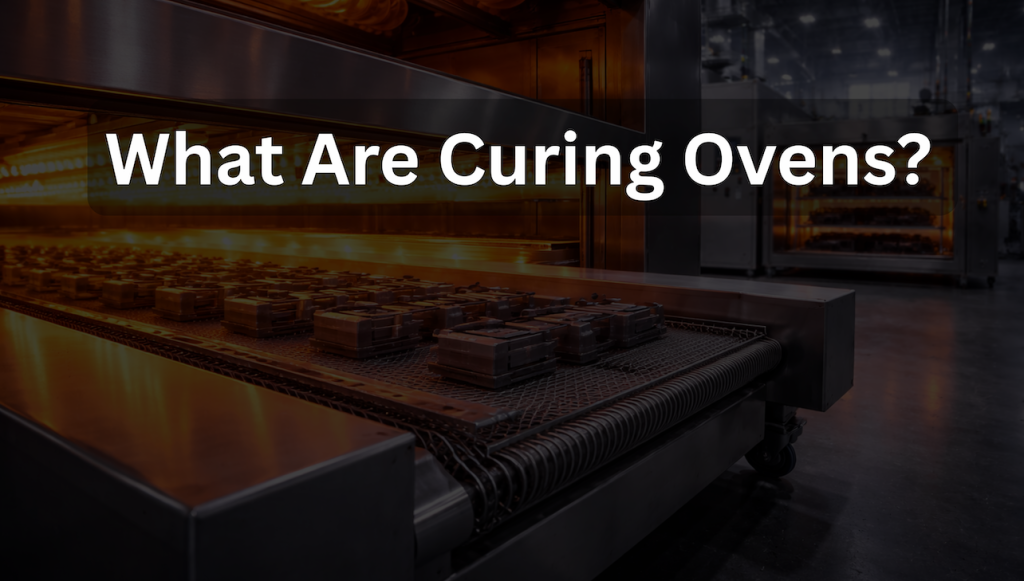
What are Curing Ovens and how do they help you ship reliable parts at scale? In plain terms, a curing oven applies controlled heat (and, in some cases, a defined atmosphere) so coatings, adhesives, rubbers, thermosets, and composites reach their final properties.
We use this step to lock in strength, chemical resistance, and dimensional stability, without adding unnecessary complexity to your line.
How Industrial Curing Ovens Work
Curing is a time–temperature process. We heat the load to a setpoint, hold for a calculated dwell, and then cool in a controlled manner. Because reaction rates depend on uniform thermal exposure, airflow design and instrumentation matter.
Our walk-in and cabinet platforms commonly run to 343 °C (650 °F), while benchtop units operate to 260 °C (500 °F). This covers low-temperature polymer cures through higher-temperature production cycles. For operations that follow formal pyrometry practices, we build systems to support SAE AMS2750 requirements for sensors, surveys, and system accuracy tests.
Where Curing Ovens Add the Most Value
We see curing ovens across aerospace, automotive, electronics, medical devices, and general manufacturing. Typical use cases include epoxy and adhesive cure, paint and powder cure, composite consolidation, and post-curing 3D-printed parts to stabilize properties.
If you’re comparing platforms, start with our Industrial Curing Ovens overview, then narrow to the chamber size and airflow pattern that fits your parts and takt time.
Choosing a Curing Oven: Temperature Uniformity, Throughput, Controls
To spec an oven that performs in production, we look at a few core inputs:
- Material and chemistry. Setpoint, ramp rate, dwell time, and atmosphere follow your resin, coating, or adhesive.
- Load geometry and capacity. Chamber volume, fixture design, and airflow direction tie directly to uniformity and cycle time.
- Throughput model. Batch works well for varied SKUs; conveyor or indexing systems shine for repeatable, high-volume parts.
- Data and compliance. Modern controls capture recipes, alarms, and audit trails. When you need pyrometry and tighter tolerances, we align features to your quality plan.
For quick comparisons, our Literature Library has datasheets and selection guides you can share with your team.
Composite and Advanced Applications
Composite curing brings extra demands. Think vacuum ports, accurate ramp/soak profiles, and stable airflow with varied layups. We address those with tailored ducting, multi-zone control, and integrated vacuum monitoring.
If your process calls for inert environments (for example, polyimide cure in electronics), we configure nitrogen or reduced-oxygen operation. For a high-level overview, see our Composite Curing Ovens.
Manufacturing Features That Drive Results
At Despatch, we design recirculating airflow to deliver uniform temperatures throughout the load space. Cold-formed sheet construction and tuned plenums help distribute heat evenly across shelves and fixtures. On joining, our steel chambers pair with proven insulation systems to minimize heat loss and reduce energy use over long dwell cycles.
Controls matter too: closed-loop PID, recipe management, and digital records make process validation and audits straightforward.
We treat controls and data as part of the process, not an add-on. You get recipe management with version history, operator permissions, and automatic data logging of setpoint, actual, alarms, and events. For audits, export run records with timestamps and thermocouple traces, then map results to lot numbers for full traceability.
If your quality plan references AMS2750, we’ll talk through sensor placement, SAT/TUS scheduling, and uniformity targets during design so qualification runs move quickly. Remote connectivity helps your team review live status and historical trends without walking to the floor, and it simplifies support.
The outcome is repeatable curing tied to clean documentation that satisfies customer and regulatory reviews
What Are Curing Ovens — Your Top Questions
How hot do industrial curing ovens run?
Most benchtop and cabinet units operate up to ~260 °C (500 °F); many walk-in models reach ~343 °C (650 °F). We size the temperature range to your chemistry and cycle time.
What’s the difference between batch and conveyor curing ovens?
Batch ovens offer flexibility for mixed parts and variable schedules. Conveyor ovens excel in continuous lines with consistent parts and strict takt targets.
Do I need AMS2750 capability?
If your contract or internal quality plan calls for formal pyrometry (surveys, SATs, TUS), you’ll want hardware and software that support AMS2750 practices. We configure that upfront so qualification runs smoothly. For the standard details, visit SAE AMS2750.
Talk to an Applications Engineer
Are you ready to learn more? We’ll review your parts, targets, and data requirements: then recommend a build that meets performance and cost goals.
Start with our Industrial Curing Ovens page or browse the Literature Library for quick comparisons, and then reach out — we’ll map your process to a validated, production-ready solution.
